
There is a kind of silence that feels louder than any explosion. It settles in after the dust, after the chaos, after the moment you realise the worst has already happened.
It’s the silence of finding out someone you love is gone through a post on your screen, before a voice ever has the chance to tell you. It’s the silence of seeing bodies laid on the ground, people who ran, who believed in the word ceasefire, who thought survival was still an option, who thought they still had another moment with the land they loved, with the people they loved, and who loved them.
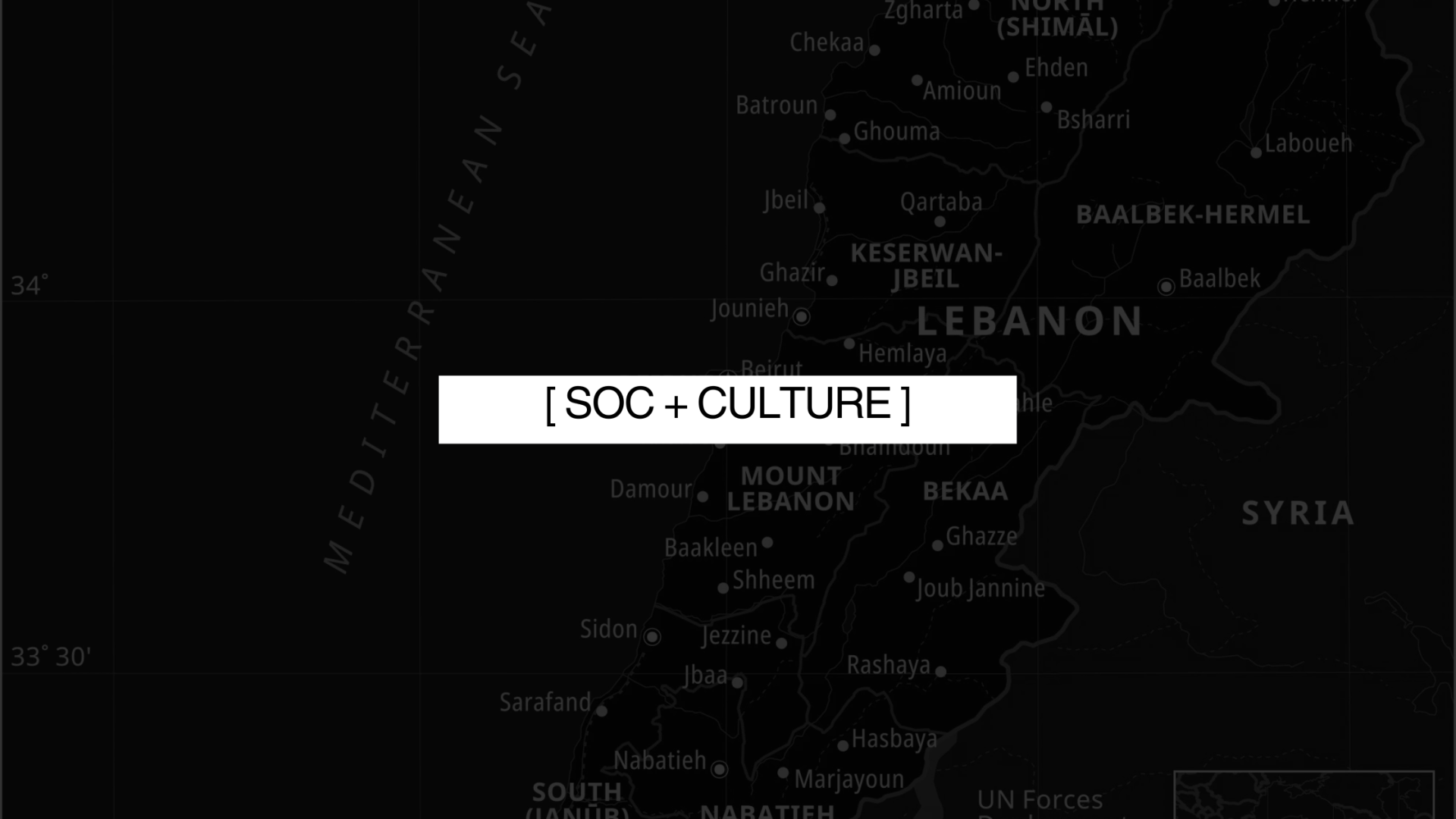
And when the villages of Southern Lebanon are erased from Apple Maps, it becomes harder to argue that any limit exists at all.
And then nothing. No warning, no accountability, just silence.
To call this “unfortunate” is to completely miss the scale of what is happening. “Unfortunate” suggests accident, coincidence, or something unintended. But there is nothing accidental about repetition. There is nothing accidental about patterns echoing over years, across borders, across generations. What we are witnessing is not an isolated tragedy; it is sustained reality.
And more than that - it has been normalised.
Not naturally, not passively, but deliberately. Normalised through language that softens impact, through headlines that blur responsibility, through a global response that has learned how to watch, react briefly, and then move on. For many in the West, this violence exists in cycles of attention. For Arabs, it exists as a constant, an inherited understanding that safety is temporary, and even that reprieve is never guaranteed.
In 2024, israel was accused of violating an officially declared ceasefire over 10,000 times. That figure alone should have knocked the world off-kilter. Ceasefire is supposed to mean pause, restraint, and an interruption of violence. But when violations reach into the thousands, the word itself becomes meaningless, reduced to a label that exists more in press statements than in reality.
And this is not happening in isolation.
So when the question is raised — does the limit exist? — it is clear that for israel it does not exist.
Because limits are supposed to function as boundaries. They are supposed to signal a point where action becomes unacceptable, where intervention becomes necessary. But what we are seeing is the opposite. The threshold keeps shifting. Each violation, each escalation, each statistic that would once have been unthinkable is absorbed into everyday discourse and the language is constantly shifting against …, not in a light that humanizes us.
For years now, children as young as four are considered adults if they are murdered in israel's bombings. Pregnant mothers shot in the stomach in front of their own children are defined as the threat.
This is what dehumanisation looks like in real time.
The tactics of systemic genocide and ethnocide in Gaza are now repeating in Lebanon, and this time, it’s being met with silence.
Not accidental silence. Chosen silence.
For years, Arabs have been reduced in Western media and politics to conflict, instability, and threat. That has consequences. It makes it easier for people to disconnect. Easier to not react. Easier to treat what’s happening in West Asia as normal.
And that’s exactly what we’re seeing now.
From the beginning of this wave of bombings in Lebanon until now, I haven’t seen a single post or acknowledgement from my student union, my university, collectives that represent or support students of all ethnicities, or even people I work with.
Nothing.
And that says everything.
What is happening in Lebanon is part of a broader regional escalation — but it is also unfolding outside the limits of current ceasefire efforts. While negotiations between the United States and Iran are being held in Islamabad, Pakistan, aimed at maintaining a fragile ceasefire after weeks of fighting, those talks do not directly extend to israel’s assault on Lebanon.
As a result, cross-border exchanges between israeli forces and Hezbollah continue. According to the United Nations, tens of thousands of people remain displaced along the border, with more than 90,000 internally displaced in southern Lebanon as strikes continue.
Reports from Human Rights Watch and Amnesty International continue to document civilian casualties and repeated damage to homes, farmland, and essential infrastructure.
The escalation is unfolding in parallel to the ongoing genocide in Gaza and the broader US —Iran conflict. Hezbollah has linked its operations to developments in Gaza, while israeli officials continue to frame northern strikes as necessary for border security. Despite this, Lebanon remains only indirectly addressed in ongoing diplomatic efforts.
This creates a gap: while ceasefire negotiations are actively being pursued at a regional level, particularly between Washington and Tehran, there is no equivalent, enforceable framework governing the Lebanese front.
In practice, that means the violence does not pause. It continues alongside negotiations, rather than being restrained by them.
Data from the Armed Conflict Location & Event Data Project shows that cross-border incidents remain ongoing, with hundreds recorded since late 2023 and continuing into the present. What is often described as “contained escalation” is, in reality, sustained conflict.
Lebanon, already in economic collapse, described by the World Bank as one of the worst economic crises globally, faces this escalation without the protections typically associated with formal ceasefire agreements.
Imagine searching for your homeland only for the result to be “the limit does not exist”
And the moment you can comprehend that is the moment where the narrative shifts. Your political affiliation has implications. Defending your party for its neutrality is the reason why we are being erased and why our homelands will never be free. It’s time to be held to account for this neutrality.
 -
-